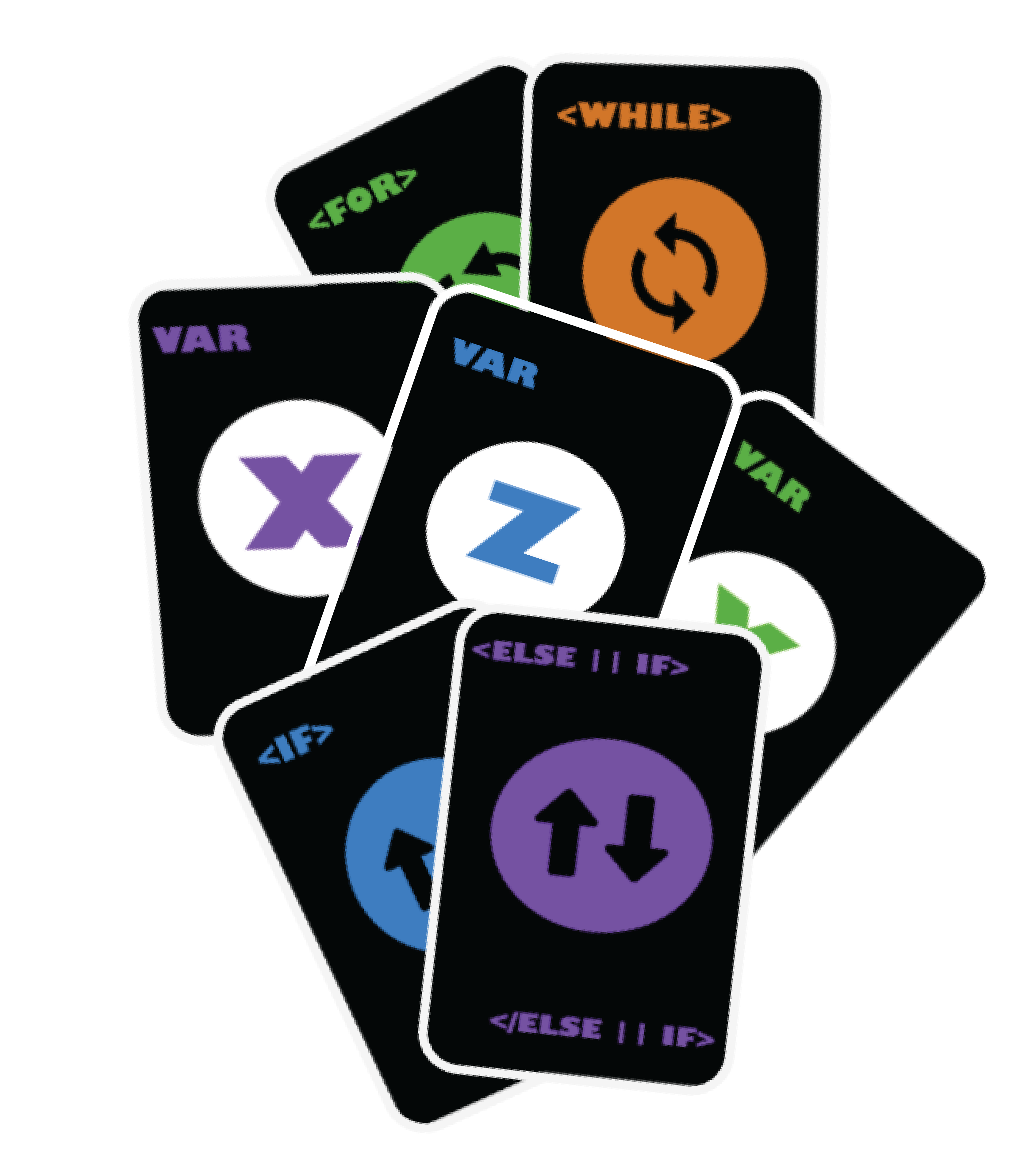
Pseudocards transforms the way you learn programming with engaging, hands-on gameplay. Designed for learners of all ages, it simplifies complex coding concepts into fun, interactive challenges.
Begin by selecting a function task card that outlines the specific challenge or problem you need to solve.
Determine the key variables needed to solve the task. Use Variable cards (X, Y, Z) to represent these variables in your logic.
Use Conditional cards (IF, ELSE IF) to establish conditions for your logic. These cards help you create branching paths based on different criteria.
Utilize Loop cards (WHILE, FOR) to repeat actions until a condition is met. This helps manage repetitive tasks within your logic.
Use Variable cards to store and manipulate data as you execute each step of your logic.
Review your logic sequence and ensure it solves the task efficiently. Test your solution to confirm it meets the requirements.
Explore the different types of Pseudocards, each designed to help you understand fundamental programming concepts through an engaging and hands-on approach.
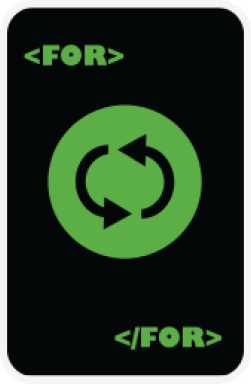
The For Loop card helps you create repetitive actions for a defined number of times, crucial for tasks that require iteration.
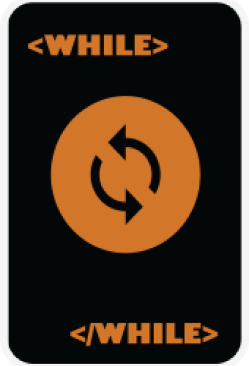
The While Loop card is used for creating loops that continue to execute as long as a specified condition is true, perfect for scenarios needing indefinite repetition.
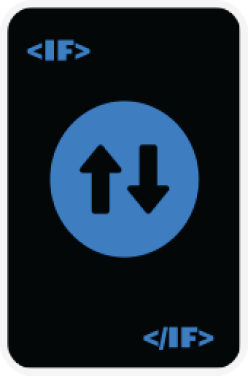
The If Conditional card allows you to set conditions to control the flow of your algorithm, enabling decision-making based on specific criteria.
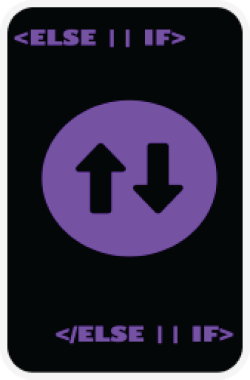
The Else If Conditional card works with If cards to create more complex decision trees, allowing multiple conditions to be checked sequentially.

The Variable card (X, Y, Z) allows you to store and manipulate data within your logic, serving as placeholders for the values you work with.
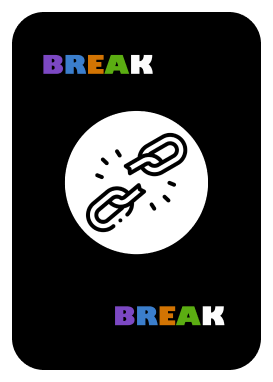
The Break card is used to exit loops prematurely, providing control over your loop's execution based on certain conditions being met.
